Mutual aid, explained in eight steps.
Mutual aid is people helping each other through hardship by sharing resources directly, without charity or a lender. At TBTF, members pledge a monthly amount first. When a reviewed case opens, they send support to the member's CashApp handle and confirm it. The recipient shows proof of use. TBTF records each step but never holds the money.
What is mutual aid?
Mutual aid is a group of people who agree in advance to support each other in an emergency.
It is not charity, because members give and receive as equals. It is not a loan, because nothing is repaid with interest. It runs on reciprocity: you show up for someone today, and the group shows up for you when it is your turn.
The Black Trust Fund (TBTF) is a private membership collective that runs mutual aid. TBTF is not a fundraiser or a crowdfunding site, and nothing is posted publicly.
How does TBTF run it?
- 1
Join the waitlist
It is free, and no payment is required today. Joining starts your formation journey.
- 2
Complete 30 days of active membership
During that time you walk the 8 Irrevocable Pillars of Community. This is the formation journey. Case access opens after it.
- 3
Set your Trust Pledge
You pick a monthly pledge of $10, $25, $50 or $100. It is a statement of intent to show up for others. TBTF does not hold your pledge as money.
- 4
Submit a case with proof of need
A case is a specific emergency, such as a repair estimate or a past-due notice. You attach the document that shows the need.
- 5
A person reviews it
Reviewers check eligibility, authenticity and fit with community standards. AI-assisted screening helps, and a person decides.
- 6
Pay the coordination fee if it is accepted
The one-time fee starts at $25. It covers round coordination, proof review and tracking. It can be waived when you qualify.
- 7
Members send support directly to you
Each member who takes part sends money to your CashApp account, then confirms in TBTF that they sent it.
- 8
You submit proof of use
A receipt or payment confirmation shows the support went to the stated need. That closes the loop for everyone who gave.
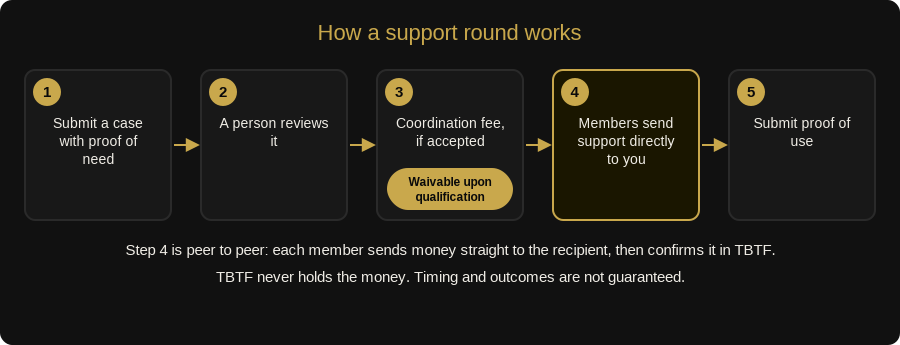
Mutual aid is not instant. A round depends on the community cycle, and no timing or outcome is guaranteed. The deadline for proof of use is in the Fund-Use and Proof-of-Need Policy.
Where does the idea come from?
The practice is centuries old. In West Africa it is called esusu. In Jamaica it is pardner, in Ethiopia iqub, and in Trinidad sou-sou.
Those circles pooled money, took turns, and kept each other accountable through reputation. There was no credit score and no collateral.
Black churches, burial societies and benevolence funds carried the same idea forward. The principle held. What was often missing was a record of who gave, who received and where the money went.
Read more about the circle model on the susu, tontine and rotating savings page.
Why does it matter now?
Many households cannot cover a surprise $400 bill from savings. A car repair or a past-due rent notice can start a spiral.
Banks, insurers and public programs were not built to catch that kind of small, fast emergency. Mutual aid fills that gap with people you have already agreed to stand beside.
What does the app add to an old practice?
Informal groups often live in a group chat and a spreadsheet. That works until the organizer burns out or the spreadsheet is lost.
TBTF puts the same steps in one place: your pledge, case notifications, contribution confirmations and proof of use. Each step leaves a record.
- Every case is reviewed by a person before it opens.
- Every contribution is confirmed by the member who sent it.
- Every recipient submits proof of use.
- Contributing members see only a first name, the case category and the amount.
For the full case path, see how emergency support works without a public ask.
How does mutual aid compare with the other options?
- A loan must be repaid with interest, and a missed payment costs you. Support from mutual aid is not repaid.
- Insurance pays under fixed terms for events it covers. Mutual aid covers a narrower set of emergencies, with no guarantee.
- A public online appeal asks strangers, and your story is posted for anyone to read. Mutual aid asks members who already committed, and it stays private.
- Family and friends help when they can. Mutual aid spreads the load across many people, so no one person carries it.
What does it cost to take part?
Joining the waitlist is free. At launch, membership is $27 a month or $247 a year.
Your Trust Pledge is separate. It is the amount you intend to give when members need help, from $10 to $100 a month.
If a case is accepted, the one-time coordination fee depends on the amount requested.
- Up to $500 requested: $25
- $501 to $2,000: $50
- $2,001 to $5,000: $100
- Over $5,000: $150
The fee is non-refundable once a round is scheduled. It can be waived when you qualify. See the Coordination Fee Policy for the details.
Common questions
Is mutual aid legal?
Yes. Private membership mutual aid networks operate as community organizations. TBTF operates as a Delaware LLC with attorney-reviewed terms and member disclosures.
How is mutual aid different from insurance?
Insurance is a contract with a company that owes you a payout under set terms. Mutual aid is an agreement between members. TBTF is not an insurance product and does not guarantee any outcome.
Does TBTF hold the money?
No. Members send support directly to the recipient, and the round total counts only contributions the sender has confirmed.
How do I start a mutual aid network for my own group?
TBTF licenses its infrastructure to organizations that want to run mutual aid for their members. Start on the For Organizations page.
How does money move without TBTF holding it?
Members send support directly to the recipient's CashApp handle, then confirm in TBTF that they sent it. TBTF never holds, receives or forwards the money. It coordinates the case, keeps the record and counts only confirmed support toward a round. Proof of use is due 3 days after payout under $2,000, or 7 days for $2,000 and over.
See where you fit.
The Trust Code Discovery takes a few minutes and costs nothing. Running a group of your own? See how organizations use TBTF.
Sources
- Preamble and Articles of Association for the Free African Society (National Park Service)The 1787 articles: members support one another in sickness and care for widows and fatherless children.
- Alternative Financial Vehicles: Rotating Savings and Credit Associations (Federal Reserve Bank of Philadelphia)How rotating savings clubs work and why people use them.