The susu taught us the rule. We added the record.
A susu, or rotating savings club, gives each member a turn at a shared pot. TBTF has no turn order and no pot. Members pledge first, then send support directly to a member with a reviewed emergency, and each step is recorded. TBTF keeps the susu's core rule: commit before you know who will need help.
What is a susu, a tontine or a rotating savings club?
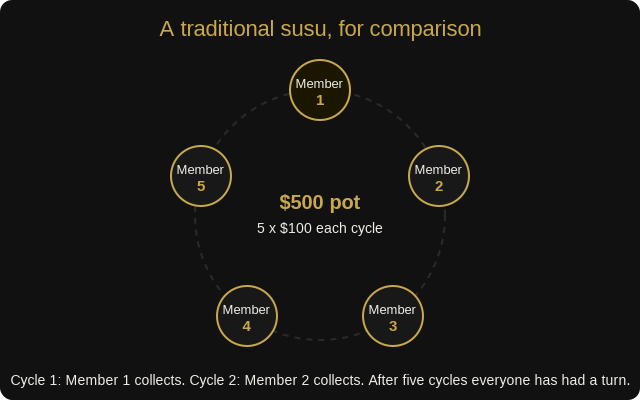
A susu is a savings circle. A fixed group of people each put in the same amount every cycle, and one member takes the whole pot each time.
Finance writers call this a rotating savings and credit association, or ROSCA. Ten people paying $100 a month means someone collects $1,000 every month, until everyone has had a turn.
The names change by place: esusu in West Africa, pardner in Jamaica, sou-sou in Trinidad, iqub in Ethiopia. The idea is the same. Your word and your reputation are the collateral.
Why do traditional circles break down?
The concept is sound. The weak point is the pot.
- A member collects early and then stops paying.
- The organizer holds the money and cannot or will not pay out.
- There is no record of who paid, so disputes turn personal.
- The group cannot absorb a member who has a real emergency out of turn.
Most circles survive on trust. When trust fails, there is nothing to fall back on.
How is TBTF different from a susu?
| Susu or ROSCA | TBTF | |
|---|---|---|
| Who gets the money | Each member in a set turn order | A member with an approved, verified emergency |
| When you receive it | On your scheduled turn | When you have a verified need and a round opens |
| What you put in | A fixed amount every cycle | A Trust Pledge you choose: $10, $25, $50 or $100 |
| Who holds the money | Usually the organizer, for a time | No one. Members send it directly to the recipient |
| How trust is kept | Reputation and relationships | Reviewed cases, confirmed contributions and proof of use |
| What it is for | Savings and lump sums | Emergencies only |
TBTF is not a ROSCA and not a savings product. It borrows the susu's core rule, which is that you commit before you know who will need help.
What does TBTF add to the circle?
The fix for the pot problem is to have no pot. Members send support straight to the recipient's CashApp account, so TBTF never holds or moves the money.
The fix for the record problem is to write each step down. Every contribution is confirmed by the member who sent it, and the round total counts only confirmed contributions.
The fix for the trust problem is review and proof. A person reviews each case before it opens, and the recipient submits proof of use afterwards. The deadline is in the Fund-Use and Proof-of-Need Policy.
Mutual aid is not instant. A round depends on the community cycle, and no timing or outcome is guaranteed. The full path is on the how mutual aid works page.
When is a susu the better tool?
A susu is the right choice when you want a lump sum on a schedule. A deposit on an apartment. Stock for a small business. A down payment on a car.
You know your turn in advance, and you can plan around it. TBTF cannot offer that. Support depends on a verified emergency and on a round opening.
Many people use both. A susu builds a goal. Mutual aid covers the surprise that would otherwise drain it.
Is this a global idea?
Yes. Rotating savings circles exist on nearly every continent. Mexico calls them tandas. In China they are hui. In Korea they are kye. In India they are chit funds.
People build them wherever banks are far away, expensive or unwelcoming. They last because they run on relationships.
In Caribbean and West African communities, circles have helped pay for homes, businesses and tuition when mainstream credit was out of reach.
Common questions
Is TBTF a susu or a ROSCA?
No. A ROSCA gives every member a turn and the organizer holds the pot. TBTF has no turn order and no pot. Support goes to a member with a verified emergency, directly from other members.
Do I get my pledge back?
Your Trust Pledge is a statement of how much you intend to give when members need help. It is not a deposit or a savings account, and TBTF does not hold it.
Can I use TBTF to save for a goal?
No. TBTF is for emergencies, not for saving, investing or earning interest. A savings circle or a bank account fits that need better.
What is the difference between a susu and a tontine?
In many Caribbean and African communities the words mean the same rotating circle. In financial history, a tontine is a pool where payouts go to the surviving members. Neither is how TBTF works.
Is TBTF a giving circle?
In spirit, yes. A giving circle is a group that commits to help its members. TBTF adds rules: members pledge a monthly amount first, a person reviews each case, support goes directly to the member through CashApp, and the recipient shows proof of use. TBTF holds no money and posts nothing publicly.
Commit before the need arrives.
Joining the waitlist is free and no payment is required today. Take the Trust Code Discovery to see where you fit.
See where you fit →Sources
- Alternative Financial Vehicles: Rotating Savings and Credit Associations (Federal Reserve Bank of Philadelphia)How rotating savings clubs work and why people use them.
- Susu: Capitalizing Development (Journal of Sociology and Social Welfare)A scholarly article on susu savings circles.